Birkin Like the Bag
There were a lot of books I read over break, mostly Agatha Christie novels, but one that stuck out to me was It Girl by Marisa Meltzer. The book followed the life and legacy of Jane Birkin, covering her romantic affairs, creative career, and cultural impact.
I was surprised that the biography actually contained very little about Birkin’s namesake bag at Hermes. I knew almost nothing about Birkin before reading the book, and what I did know turned out to be part of a mass misunderstanding of her life.
I originally thought Jane Birkin was the ultimate it girl, a Parisian socialite known for her bohemian style and influence. I then learned that Birkin was actually from London, Paris serving as her adoptive home. The city embraced her, recognizing that she embodied Paris’s mood, regardless of her amateur French. She spoke a more important language: style.
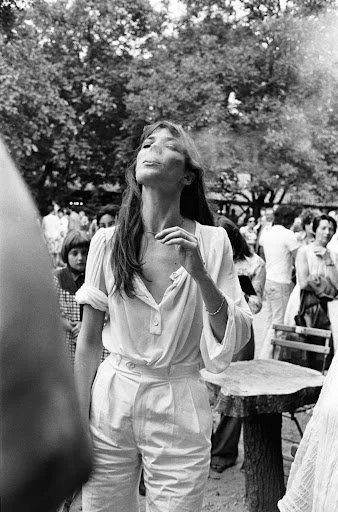
Birkin had style instincts that can’t be taught. She was relaxed, effortless, and reliant on her own girlish charm. She wasn’t striving for fame or notoriety through her clothes. She invented the signature look; she was individual before individuality.
Jane spent most of her life as a muse to great men: Serge Gainsbourg, John Barry, and Jacques Doillon. Her relationships with men were controlling, consuming, and even sometimes abusive. She didn’t shy away from a fight. The lasting impression I got from her biography was that her life was largely defined by romance. This wasn’t the Birkin I was expecting–her legacy, in my eyes, is largely untouched by men. Her life, however, was dominated by them.
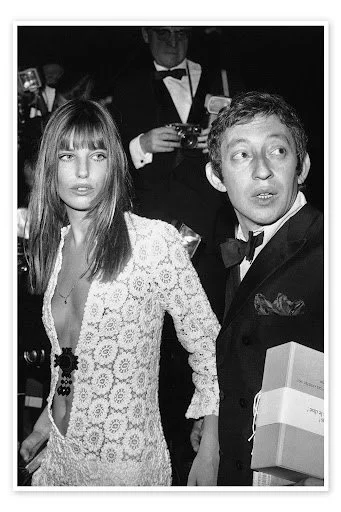
Perhaps the most surprising thing I took from It Girl was how small a role the Birkin bag played in her life. The story is that Jane was flying from London to Paris in 1983, with her signature basket bag in shambles after it was run over by Jacques Doillon’s car during an argument. The man seated next to her on the plane suggested that she buy a bag with pockets. Birkin responded that when Hermes made a bag with pockets, she would buy it. It turned out that the man seated next to her was Jean-Louis Dumas, the chief executive of Hermes. Jane sketched the Birkin on the airsick bag in front of her, and the rest is history.
Jane Birkin treated her Birkin bag as she did her basket bag, crammed with anything and everything, beaten up by various fights with lovers, adorned with stickers and keychains. She wasn’t precious about the bag, true to her spirit. Her treatment of the Birkin wasn’t performative; it was authentic.
What surprised me was that the Birkin bag was a blip on Jane's radar, just one event in a life of millions. She spent her life singing and acting, inventing style and influencing culture. And yet she is remembered for a bag, a bag for which she gains no royalties.
More disappointing for me, I think, was that when I looked past the bag and read her biography, I found a life defined by the men in it. At first, I was frustrated with the author for representing her life in such a male-centric way, but then I realized it was just the truth. While entirely original, individual, and influential, Jane Birkin was also entirely swept up by love. It Girl covers Jane’s life and legacy–both of which are obscured.
Jane Birkin isn’t the modern, empowering it girl I was expecting, but that’s not the life she wanted. She lived her life on her own terms, and that included tumultuous relationships and contentious choices. It’s surprising to me that someone so unflinchingly authentic can have a legacy that so misrepresents their true spirit.
Jane Birkin passed away in Paris in July 2023. She lived many lives, on screen and off. I was happy to read that she starred in the movie adaptation of Agatha Christie’s Death on the Nile (I am definitely the target audience for this). BOS readers, I encourage you to learn more about your style icons–they might surprise you.